
“A finding you can’t trace to evidence is just your opinion in a formal font.”
Quality Auditing Fundamentals is built for two people: the professional who audits — or gets audited — and wants to do it competently, and the candidate preparing for the ASQ Certified Quality Auditor examination. It covers audit types and their purposes, planning and preparation, conducting the audit, objective evidence and audit trails, findings and nonconformity reporting, corrective action and follow-through to closure, audit program management, auditor ethics and conduct, and the quality tools, sampling methods, and basic statistics an auditor is expected to use.
Most people who audit badly aren't unqualified — they've just never been taught the difference between a finding and an opinion. This course teaches auditing as a disciplined, evidence-based process: what constitutes objective evidence, how a nonconformity is written so it survives challenge, and why an audit that closes without verified effectiveness didn't close. Online, self-paced, start any time.
Quality Auditing Fundamentals · $499
Auditing fundamentals for quality professionals and ASQ CQA candidates. Covers audit types and purposes, planning and preparation, conducting the audit, objective evidence, findings and nonconformity reporting, corrective action and closure, audit program management, auditor ethics, and the quality tools and sampling methods auditors are expected to use. Online, self-paced, start any time. Includes topic quizzes, a practice exam, and a dated record of training hours.
For CQA candidates, this course covers the knowledge areas the examination draws from. The CQA exam is open book — but at 165 questions in 5 hours 18 minutes, it rewards knowing the material, not looking it up.
CQA ELIGIBILITY REQUIREMENTS
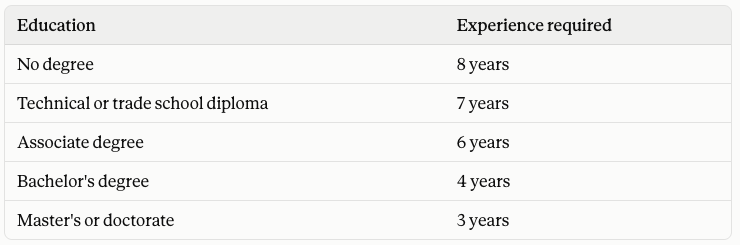
Certification is issued by ASQ, not by a school. ASQ requires eight years of work experience in the CQA body of knowledge, three of which must be in a position with authority to define, execute, or control projects or processes. Education reduces the requirement:
Only one education waiver may be claimed, and all experience must be from full-time paid roles. The three years in a decision-making position are required at every education level.
AMS Level 3 teaches the material. ASQ certifies you.
This course builds the knowledge the CQA examination draws from and documents your training hours. Eligibility, application, and certification are handled by ASQ.